

Back to Community Development
Community Development
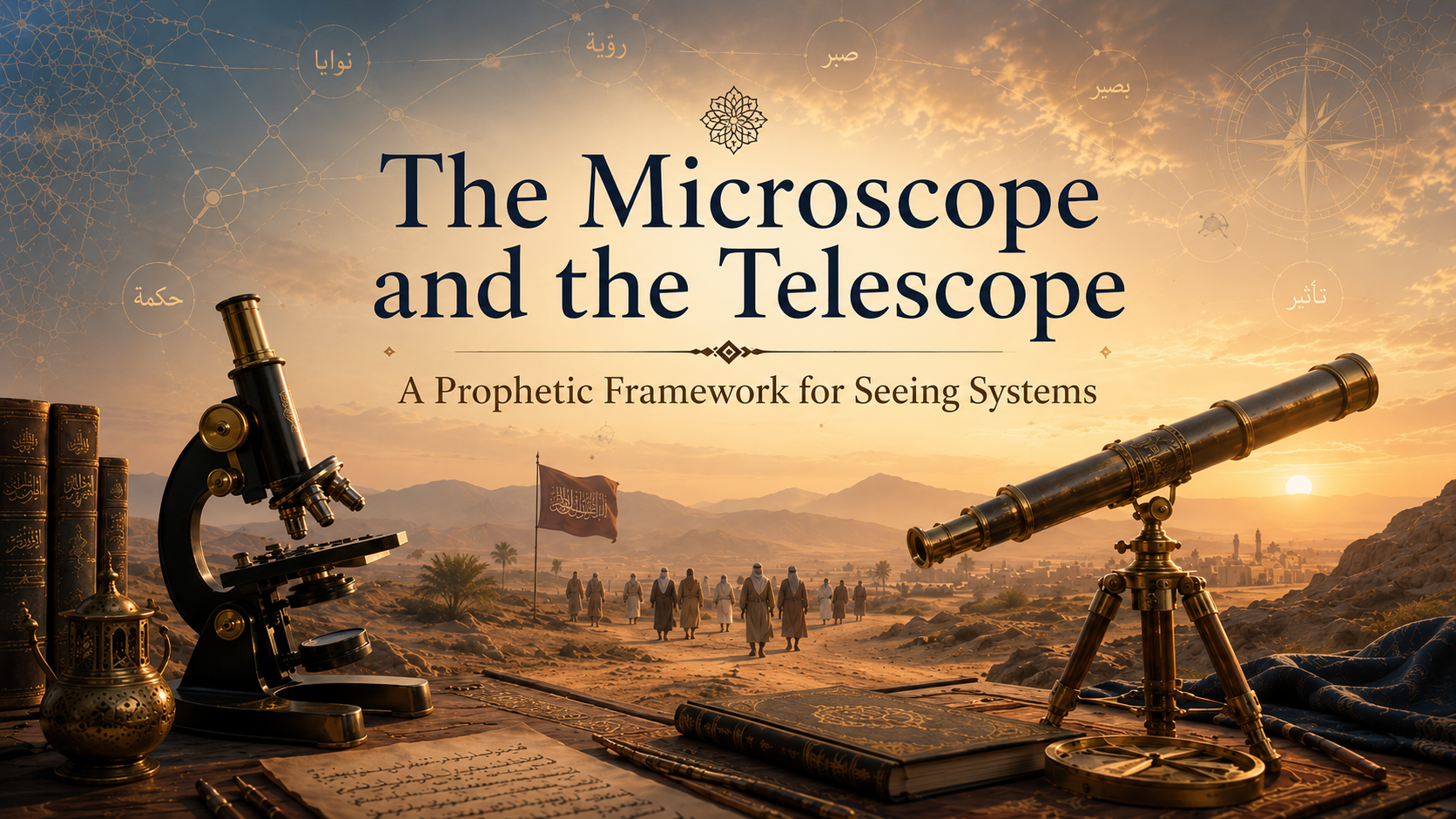
The Microscope and the Telescope: A Prophetic Framework for Seeing Systems
Drawing on the Treaty of Hudaybiyah and systems thinking, this reflection explores how our mental models shape the way we read crises, communities, and change, and what prophetic wisdom teaches us about seeing near and far at once.
The Microscope and the Telescope: A Prophetic Framework for Seeing Systems
The Treaty of Hudaybiyah has always been one of the most fascinating moments in the Seerah to reflect upon. Yet the question that continues to capture my attention is not the familiar one of why the companions found the treaty so difficult to accept. It is a more precise and perhaps deeper question: what did the Prophet ﷺ see in that moment that they could not yet see?
I say this because the Prophet ﷺ was not detached from the emotion of the moment. He saw the chains of Abu Jandal رضي الله عنه. He witnessed the anguish and frustration of ʿUmar رضي الله عنه. And we know that the companions were among the greatest human beings to ever walk this earth. Their struggle with the treaty, upon its conclusion, was not born of weakness; rather, it was sincere reasoning in response to what stood before them.
The difference, therefore, at least as I understand it, was not a matter of emotional capacity or moral courage. It was a difference in perspective, shaped by different mental models of the situation. The Prophet ﷺ, as the recipient of revelation, was reading the moment through a wider and truer map of reality.
The Sensitivity of Mental Models
When ʿUmar رضي الله عنه asked his famous questions, 'Are we not upon the truth? Are they not upon falsehood? Why then should we accept humiliation in our dīn?” He was not speaking irrationally. Within the framework through which he was reading the moment, his questions were entirely reasonable. He was responding with conviction, honour, and logic according to the model of change that appeared most obvious before him.
His model was direct and coherent: truth faces falsehood, truth prevails, and the mechanism of prevailing can require confrontation. This is a perfectly reasonable model and is at times the only prevailing way.
But the Prophet ﷺ was operating with a more complex model. It could be deduced that from His ﷺ perspective, He ﷺ understood that the primary barrier to Islam’s spread was not simply Quraysh’s military strength. It was that people across Arabia had been unable to encounter Islam without the pressure of tribal warfare shaping their response before they had even been given space to think.
Conflict had created a system in which every interaction between Muslims and non-Muslims was immediately coded as a threat and counter-threat. In such an environment, Islam was not being encountered on its own terms. Many people were responding to the politics of the conflict before they had truly listened to the message itself. The treaty altered that environment by creating a pause in the machinery of confrontation, and that pause allowed conversations, journeys, relationships, and reflection to take place in a way that had previously been restricted.
And this is not merely a historical observation! In some of the important discussions I have personally witnessed, including discussions concerning the community, I have seen valuable contributors hesitate to participate or develop their thought-capital because of the fear of backlash. The problem is not always that people have nothing meaningful to contribute. At times, they have much to offer, but the atmosphere has become so charged that speaking feels costly before the idea has even been properly heard.
When an environment reaches that point, the damage is not limited to the conversation itself. It begins to affect the way people think, prepare, and contribute. Instead of allowing ideas to be tested, refined, corrected, and strengthened through sincere exchange, people begin to hold them back out of fear that they will be attacked before they are properly understood. Discussions that should be given time to mature end up becoming defensive from the beginning, and communities can end up deprived of sincere and capable minds, not because those minds had nothing to offer, but because the climate around them made meaningful contribution too costly.
Circling back, the treaty most definitely did not surrender the goal. Rather, it changed the conditions through which the goal would be reached, and within two years, more people entered Islam than had in the entire preceding period. Khalid ibn al-Walid رضي الله عنه came. ʿAmr ibn al-ʿĀṣ رضي الله عنه came. The very mechanism by which the Quraysh had sustained resistance, the war footing that made neutrality impossible, was dissolved.
And this is what Allah Almighty described as a fatḥ mubīn (a clear opening). It was not merely a spiritual reassurance after a difficult moment, nor a consolation for what appeared to be a loss. It was an exact description of what the treaty had actually achieved, as it opened a new reality in which the message could move, be heard, and consolidate in ways that had previously been blocked.
So the lesson here is not simply "be patient and trust Allah", though that is true and necessary. The lesson is that our mental models, or the maps we carry for how change happens, how relationships work, and how communities develop, are often far too simple for the systems we actually inhabit.
Systems Behave Differently From How They Look
There is a property of complex systems that is well understood in other fields but rarely discussed in Islamic discourse: the gap between where an action is taken and where its effects are felt, and between when an action is taken and when its consequences arrive.
Peter Senge describes this in The Fifth Discipline as the problem of time delays. His point is that when many factors are interacting at once, there is often a significant gap between an action and its visible result. Because people cannot yet see the effect of what they have done, they assume that nothing is happening or that the action was too weak. They then respond by applying more pressure.
The difficulty is that the system may already be responding to the first action, even though the response has not yet become visible. By acting again, and with greater force, they send a second and stronger signal into a situation that was already in motion. What follows is often not clarity or progress, but distortion or overcorrection, with unintended consequences.
And this is precisely what sabr addresses at its structural core, for in Islam, we are taught consistently that sabr is not merely the emotional endurance of difficulty. Rather, sabr is a form of epistemic discipline, i.e., the refusal to read a system before its response has arrived.
The parent who plants habits of tarbiyah in a ten-year-old will not see the harvest at eleven. The community that invests years into genuine scholarship, transparent governance, and patient institution-building cannot measure the return in a single financial cycle. The believer who does the inner work of purifying their character will not notice the change in themselves until others name it.
Accordingly, when we see no immediate result and respond by abandoning what was already working or by increasing pressure in order to force a quicker outcome, we may think we are being strategic, when in reality we may simply be misreading the delay between cause and effect and thus being defeated by the time delay.
This helps us appreciate Hudaybiyah with greater depth. The treaty did not produce its full fruits the moment it was signed. In fact, at first glance, it appeared to produce the opposite: disappointment, emotional strain, and terms that seemed difficult to accept. Yet the Prophet ﷺ understood this gap. He remained firm upon the course he had taken, not because the truth had become unclear nor because the pain of the moment was insignificant, but because he understood that the fruits of the treaty would not appear immediately. He was prepared to bear the pressure of that difficult middle period, when the wisdom of the decision had not yet become visible to others, while the very conditions that would make its success possible were already being set in motion.
Escalation: The Most Destructive System We Ignore
There is a system archetype, or recognisable pattern of behaviour in complex systems, called 'escalation'. It is worth naming directly because it governs a significant proportion of the damage in our families, our communities, and our organisations.
Escalation works like this:
- One party takes an action that feels, to them, like a reasonable and proportionate response.
- The other party experiences that action as threatening and responds in kind, also reasonably and proportionately, from their perspective.
- The first party now receives a response that is stronger than their original action and escalates again.
Each party, at each step, is reacting to what the other side just did, not to the original issue. The original issue has long since been buried!
Within a few cycles, you have two people, or two factions, or two institutions, who have forgotten what they were originally in dispute about, locked in a dynamic that neither chose and neither knows how to exit because the conflict has taken on a life of its own.
This is not a description of weak people, nor of communities that lack sincerity or intelligence. It is a description of what can happen when capable and well-intentioned people are operating within a system whose deeper patterns they have not yet learned to recognise.
The Islamic tradition has always prescribed what the systems literature would call 'circuit-breakers': the injunction to seek reconciliation, the prohibition on cutting family ties beyond three days, the emphasis on a third party in disputes, and the theological grounding that makes capitulating to your ego in conflict a matter of character rather than merely good manners.
These are not merely soft suggestions or general calls for better manners, but deliberate interventions that change the structure of the interaction itself, interrupting escalation before it gathers enough momentum to sustain and reproduce itself.
The Prophet ﷺ at Hudaybiyah refused to enter the escalation dynamic even when every emotional instinct and every legitimate grievance pointed in that direction. He absorbed the pressure of an unjust-looking moment rather than allow it to drive the system into a pattern that would cost the Ummah far more. His ﷺ modus was not passivity in any shape or form, but a disciplined awareness of the forces at work within a situation, and the ability to respond in a way that shapes those forces rather than being shaped by them.
Where the Microscope Fails Us
The microscope and the close examination of what is immediately in front of us is not merely a useful tool. It is, for most people, the default mode of operation. We naturally feel the weight of what is nearest to us, respond to what has just happened, and carry most vividly the hurt that is freshest in our memory.
This is not necessarily a character flaw but a natural part of how human beings often process reality. We naturally give more emotional weight to what is close, immediate, and recently felt. The Qur’an does not correct this by asking us to pretend that the near does not matter, but by training us to give proper weight to what is distant, unseen, and still to come.
This is why the ākhirah is not presented as an abstract doctrine that sits separately from daily life. It is presented as a real and approaching event that should actively reshape how we speak, decide, react, forgive, restrain ourselves, and pursue justice today. Allah Almighty says:
مَا يَلْفِظُ مِنْ قَوْلٍ إِلَّا لَدَيْهِ رَقِيبٌ عَتِيدٌ
“Not a word does he utter except that there is with him an observer prepared to record.”
In this sense, the Qur’anic insistence on accountability for every word spoken extends the time horizon of every interaction. A sentence is no longer just a sentence in the heat of the moment. It becomes something carried forward, recorded, and returned to us before Allah. That awareness changes the structure of our response: it slows the tongue, disciplines the ego, and reminds the believer that what feels urgent now must still survive the scrutiny of the ākhirah.
The danger of the microscope is not that it shows us wrong things. It is that it shows us real things in isolation, without the structural context that would tell us what those things mean...
A husband who remembers every instance of criticism from his wife, catalogued and weighted, is perceiving accurately. But if he does not see how his own emotional unavailability generated those criticisms as a feedback response, i.e., if he cannot read the loop he is part of, then his accurate memory becomes a tool for reinforcing a system neither of them would choose.
Likewise, a community leader who documents every financial irregularity, every governance failure, every moment of poor adab from a rival faction may be entirely correct in every particular. But if the act of documentation and dissemination is itself adding fuel to an escalation dynamic, then correctness about the past has become an engine of damage to the future.
The microscope, without the telescope, does not produce justice. Rather, it produces a very well-evidenced impasse.
Where the Telescope Fails Us
But the reverse failure is equally real, and in our particular cultural moment, arguably more common.
The telescope, which is supposed to be the vision of purpose, the picture of the long arc of the Ummah, and the invocation of unity and brotherhood; is frequently deployed not as a genuine systems perspective but as a way of suppressing the microscope.
"Let us not dwell on what happened. Let us focus on the bigger picture. Let us not allow the Shayṭān to divide us. Zoom out, do not zoom in"
Sound familiar?
These are not wrong statements, but in the same breath, they can also be used to silence accountability, protect the powerful, bury harm, make prevailing truths insignificant, and ensure that structural problems are never addressed, which means they will resurface, in the same or a more acute form, at the next crisis.
This is the system archetype of shifting the burden: applying a symptomatic solution (emphasising unity, performing reconciliation for example) to relieve the immediate pressure, while the underlying structure that generated the problem remains untouched.
The symptomatic solution feels good as it reduces tension and produces a group photo; yet, equally, it guarantees that the same problem will return.
True synergy between the two requires that the telescope does not override the microscope, but gives it context. It does not ask us to ignore what is visible up close nor to minimise the pain, detail, or urgency of the present moment. Rather, it asks a deeper question: given what we can see before us, what kind of response would improve the structure of the whole situation, not merely produce a better outcome for this week?
This is very different from simply asking, “How do we make this problem disappear?” It is a harder and more honest question, because it requires us to sit with discomfort rather than merely manage appearances. At times, it may also require the painful admission that the issue is not only a misunderstanding, a personality clash, or a temporary difficulty, but also a deeper design flaw within an organisation, relationship, or approach that goodwill on its own will not be enough to repair.
The Prophet ﷺ did not ask the companions to stop feeling the weight of Hudaybiyah. Their grief was real, and their difficulty in absorbing the moment was not dismissed. But he directed them towards action: to slaughter their sacrificial animals and shave their heads so that the moment would be embodied as a decision of obedience, not interpreted as a collapse into defeat. He held both instruments at once: the pain of the microscope was acknowledged, while the discipline of the telescope still guided the response.
Leverage and the Prophetic Instinct
Donella Meadows, in her landmark work on systems thinking, proposed that the most powerful leverage point in any system is not its rules or its flows; it is the goal of the system, and deeper still, the mental models that determine what goals are considered possible.
At Hudaybiyah, the Prophet ﷺ changed the immediate goal around which the situation was being organised. The goal was not changed from “truth must prevail”; it remained the same. Rather, it shifted from “ʿUmrah must be performed now” to “the conditions must be created for Islam to spread.” Once the moment was understood through that wider frame, an entirely different set of outcomes became possible.
This is where the isthmus (narrow strip) between the microscope and the telescope is actually located: not in being patient, but in asking whether our model of what we are trying to achieve is adequate to the situation we are in.
For families, the leverage question is rarely "Who was wrong in this argument?" It is "What is the relational system we have built, and does it have the structure to sustain the marriage, the children, and the extended family we want?" The first question drives the microscope toward forensics. The second drives the telescope towards architecture.
For communities, the question of leverage is rarely only, “Which faction holds the correct position?” A deeper and often more consequential question is whether the community has the institutional structures needed to survive disagreement with integrity: clear shūrā processes, financial transparency, conflict-resolution mechanisms, scholarly accountability, and trusted pathways for raising concerns.
Without these structures, the question of who is right can become difficult to resolve because the system has no reliable way to process disagreement without producing fracture. Truth still matters, of course, but a community also needs mechanisms through which truth can be heard, assessed, corrected, and acted upon without every serious difference becoming a crisis of unity.
For the Ummah, and this is perhaps the larger question to which Hudaybiyah continues to speak, leverage does not lie merely in a particular political manoeuvre, a temporary advantage, or a rhetorical victory over an opponent. It lies in whether we are building the deeper conditions through which Islam can be carried with clarity and credibility in every age: sound institutions, serious scholarship, educated communities, principled leadership, and an internal culture in which accountability and mercy are not treated as opposites but as conditions of Prophetic witness.
Living in the Gap
There is something the scholars of Islam have always understood, even if it has rarely been framed in the language of systems: that the dīn itself is a comprehensive intervention in how human beings see, understand, and respond to the world they inhabit.
The maqāṣid al-sharīʿah (the preservation of dīn, life, intellect, lineage, and wealth) are not simply a list of things Islam protects. They are a description of the system conditions required for human beings to flourish. Fiqh is not merely the adjudication of individual cases; it is the accumulated wisdom of generations of scholars mapping the interaction between revelation and the complex, dynamic reality of human communities across time.
The Prophet ﷺ was the most complete embodiment of this comprehensive sight. He could see the chain of Abu Jandal رضي الله عنه, and he could see the Conquest of Makkah on the same day, without one vision cancelling the other. He could be fully present to the pain of his companions and fully clear about the path required. He did not oscillate between the two instruments as though one had to be set aside for the other. He held them together, allowing the nearness of the pain to be fully seen while allowing the wider horizon of revelation and strategy to govern the response.
That is the capacity this moment calls for. Not the false confidence of those who use the telescope to avoid accountability, and not the exhausting rightness of those who use the microscope to avoid responsibility for where things are heading. But the harder and more distinct prophetic stance is to see the wound clearly, to name it honestly, to refuse both the shortcuts of denial and the dead-ends of obsession, and to ask with whatever wisdom, consultation, and tawakkul we can muster: "What structural response will build the future Allah is pleased with?"
The companions came to understand Hudaybiyah in time, from the other side of its outcomes, when they saw what the treaty opened, what it prevented, and how what first felt painful became a means of expansion and victory.
We are rarely given that same luxury. More often, we are required to act before the results are visible, to hold our nerve before the wisdom has unfolded, and to trust that the present moment, however intense, is not the whole story. This is not merely a test of temperament or patience but a test of whether we have learned to read situations with prophetic discipline, and not with the certainty of knowing the future, for that belongs to Allah alone, but with enough faith, restraint, and clarity not to let the pressure of the immediate moment become our entire map of reality.
This is where the microscope and the telescope must finally meet.
Your brother
Sajid Umar
Location: 'somewhere en route to the hereafter'
02/12/1447 (AH) - 19/05/2026
Sajid Umar
Location: 'somewhere en route to the hereafter'
02/12/1447 (AH) - 19/05/2026




Asalaamualikum Ustaad,
I hope you are in the best of health. I am really grateful that you wrote this piece. May Allah reward you for it. There could not have been a better time for me to see this. I am currently trying to build systems within our Islamic school, and it is especially challenging. Alhumdulillah, I have fantastic support around me but there are always some short-sighted people that make you feel like you are delusional. I will be taking your written work and sharing it with other sisters, to help us ‘to get out of the microscope and start looking through the telescope’. We will reflect on the importance of sincerity in action, movement, holding the vision and having sabar. JazakAllah khair. Please keep sharing more of your work.
JazakAllahu khairan Shaykh for this much needed , profound perspective. We cannot emphasise enough the need for such proactive strategies with streamlined framework which is based on sound understanding and implementation of Faith . I think every sector and relationship will benefit from this meeting of scopes. Allah bless you to educate and inspire more.
I would recommend this article by Dr. Sajid to any leader, community organizer, business owner, or anyone responsible for shaping people, systems, and institutions.
One of the most powerful takeaways is the reminder that success is not achieved merely through goals, but through the systems that support them. This reflection frames that concept through an Islamic lens, drawing from the Treaty of Hudaybiyah and the Prophetic approach to leadership, strategy, accountability, and change.
What I found particularly compelling is how it reconciles two ideas that are often treated as opposites: remaining focused on the ultimate goal of pleasing Allah while still being accountable for the structures, processes, and decisions that shape our path toward that goal.
Whether you are leading a family, a community, or an organization, this is a valuable reminder that sometimes the most important changes are not to our objectives, but to the systems through which we pursue them.
Jazakallah Khair Dr. Sajid.
Jazākumullāhu khairan. This is indeed insightful.